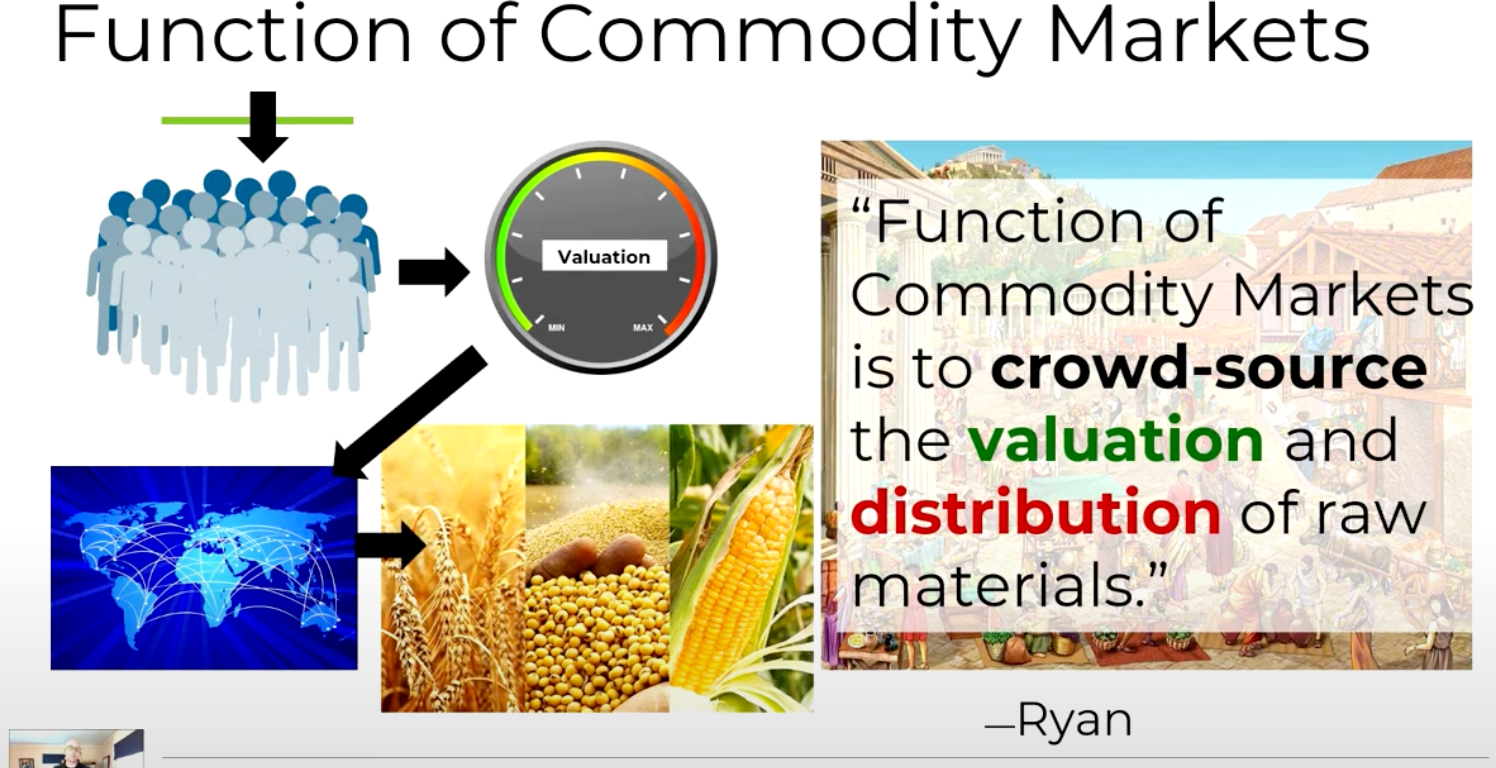
Commodity markets are the backbone of the global economy, facilitating the exchange of essential raw materials. This essay delves into the function of these markets, explores the concept of a commodity, and analyzes the trade distribution system through physical and futures markets. Furthermore, it examines the unique case of coffee and its position within this complex system.
Crowdsourcing Knowledge: The Function of Commodity Markets
The primary function of commodity markets lies in crowdsourcing the valuation and distribution of raw materials (Peterson & Tomek, 2005). This crowdsourced mechanism leverages the ‘wisdom of crowds’ – a concept first explored by Sir Francis Galton (1907) in his groundbreaking study on the remarkably accurate average guess of an oxen’s weight. Similarly, commodity markets aggregate the diverse perspectives of numerous participants to arrive at a collective ‘expert answer’ on a commodity’s value. This crowdsourced value manifests as the market price (MacKay, 2004).
What is a Commodity?
Several key characteristics define a commodity. First, commodities possess intrinsic value derived from their utility as production inputs, unlike finished goods whose value is determined by consumer demand (Peterson & Tomek, 2005). Second, a true commodity exhibits a high degree of homogeneity, enabling bulk purchases with minimal inspection of individual units (Irwin & Sanders, 2011). This uniformity allows for standardized contracts and facilitates efficient trading.
Producers and consumers inherently have opposing interests within a commodity market. Producers seek higher prices to maximize profit margins, while consumers naturally desire lower prices to stretch their purchasing power (Geman, 2005). Ideally, an effective commodity market balances these conflicting needs, allowing producers and retailers to earn a profit while ensuring consistent commodity availability (Wright & Williams, 2011).
Basic economic principles govern this price-setting dynamic. As prices increase, supply tends to rise due to increased production incentives. Conversely, demand typically falls as consumers are priced out of the market. Conversely, when prices fall, supply may contract as production becomes less profitable, while demand often rises as consumers are drawn to the lower prices (Tomek & Garcia, 1997).
Is Green Coffee a True Commodity?
Green coffee, the unroasted form of coffee beans, undeniably possesses intrinsic value as a production input. However, its status as a homogeneous commodity is debatable. Coffee exhibits significant variation based on factors like origin, species, varietal, bean size, processing methods, and other aspects that influence quality (Daviron & Ponte, 2005). These variations can significantly impact the final product’s taste and aroma.
Despite this heterogeneity, we can understand green coffee through a lens similar to a valuable object like a golden sculpture. The sculpture’s value extends beyond the raw material (gold) itself. It incorporates craftsmanship, historical significance, and unique characteristics that elevate its worth. Similarly, exceptional coffees with distinctive profiles transcend their status as mere commodities (Daviron & Ponte, 2005). Specialty coffee producers often leverage origin stories, unique processing methods, and meticulous quality control to differentiate their offerings from generic bulk coffee.
Distribution Systems in Commodity Markets
Commodity markets operate through two interconnected systems: physical markets and futures markets (Peterson & Tomek, 2005). Physical markets govern the transfer of physical commodities from producers to consumers across geographical locations. Standardized forward contracts underpin trade in the physical market. These contracts establish responsibilities for both buyer and seller, including details like quantity, quality, price, location, and most importantly, the timing of the transaction (Distel & Galbinski, 2010).
Timing plays a crucial role in physical commodity markets for two key reasons. First, transporting commodities takes time, necessitating forward planning to ensure products arrive when needed. Second, production and consumption cycles often do not align perfectly. For instance, coffee production is concentrated within specific harvest periods, while consumption occurs throughout the year at a steadier pace (Distel & Galbinski, 2010).
Trade houses act as intermediaries to bridge this gap between production and consumption cycles (Garcia & Miranda, 2004). They achieve this by strategically entering into forward contracts. Trade houses can buy from farmers pre-harvest, during harvest, or post-harvest, effectively smoothing out the flow of coffee between production and consumption curves. Their ability to hold inventory is essential for this function, allowing them to manage the time discrepancies between production cycles and consumer demand. The evolution of trade between trade houses ultimately led to the creation of futures markets.
The Futures Market and Hedging
Futures markets are where standardized forward contracts are traded (Irwin & Sanders, 2011). Standard terms regarding contract size, quality, delivery locations, and expiry dates facilitate liquidity by making these contracts easily interchangeable (Garcia & Miranda, 2004).
Crucial to maintaining the relevance of the futures market is its relationship to physical commodity prices. This relationship hinges on certified inventory or certified stocks. These are inspected and approved units of a physical commodity held in exchange-approved warehouses and can be exchanged for futures contracts (Irwin & Sanders, 2011). The tender and delivery process ensures alignment between futures prices and physical prices. As futures contracts near expiry, holders must either close their positions (trade out of the contract) or enter the notice period, converting their contract into an obligation to deliver or accept physical goods (Geman, 2005). This mechanism binds futures and physical markets, ensuring that price convergence occurs.
Actors within Futures Markets
The primary participants in futures markets are commercials, speculators, and financial institutions. Trade houses and other large commercial entities actively participate on both sides of the market. They may trade on behalf of roasters (buying futures) or producers (selling futures) to manage risk (Peterson & Tomek, 2005). Since every futures trade requires a buyer and a seller, speculators act as counterparties to these commercial trades (MacKay, 2004). They add liquidity and often bet on whether prices will rise or fall. Financial institutions play an intermediary role, serving clients like index funds that seek exposure to a basket of various commodities (Irwin & Sanders, 2011). The result is a highly liquid market where producers and consumers can easily find counterparties for their transactions.
Commodity Markets and Coffee Differentiation
Interestingly, while commodity markets are designed to deal with undifferentiated goods, they can paradoxically facilitate the ‘decommodification’ of certain coffees. Hedging strategies with futures can lock in a selling price, isolating a specific coffee from broader commodity price swings (Distel & Galbinski, 2010). This empowers growers who invested in superior quality, allowing their coffee’s unique characteristics to stand out in the market (Daviron & Ponte, 2005).
By reducing exposure to market volatility, hedging can incentivize farmers to pursue higher quality and differentiate their product. This benefits both sides: consumers gain access to better, more diverse coffee choices, and farmers are shielded somewhat against unpredictable commodity markets (Distel & Galbinski, 2010). In this way, hedging creates space for ‘specialty’ coffee markets where the value is not solely determined by the base commodity price.
Commodity markets are intricate global systems that orchestrate the valuation and distribution of essential raw materials. Through a complex interplay of commercial entities, speculators, and financial institutions within both physical and futures markets, these systems balance the interests of various stakeholders. Coffee stands as a fascinating case study in commodity markets. While its raw form (green coffee) has commodity characteristics, the potential for differentiation through quality, origin, and marketing strategies exemplifies how producers and roasters can navigate the commodity landscape to capture greater value.
References:
- Daviron, B., & Ponte, S. (2005). The coffee paradox: Global markets, commodity trade and the elusive promise of development. Zed Books Ltd.
- Distel, J., & Galbinski, V. (2010). Commodity risk management: Understanding the tools for mitigating physical and financial price risk in agriculture. Commodity Risk Management Group, The World Bank.
- Galton, F. (1907). Vox populi (The wisdom of crowds). Nature, 75(75-198), 450-451.
- Garcia, P., & Miranda, M. (2004). Institutional change and international price transmission in the coffee market. In G.G. Schluter & C.J. Morales (Eds.), Transformations in world coffee trade, (pp. 83-118). Food and Agriculture Organization of the United Nations.
- Geman, H. (2005). Commodity and commodity derivatives: Modeling and pricing for agriculturists, manufacturers, and investors. John Wiley & Sons.
- Irwin, S., & Sanders, D. (2011). Index funds, financialization, and commodity futures markets. Applied Economic Perspectives and Policy, 33(1), 1-31.
- MacKay, C. (2004). Extraordinary popular delusions and the madness of crowds. Barnes & Noble.
- Peterson, H., & Tomek, W. (2005). How commodity markets work. Agricultural Marketing Resource Center. https://www.econ.iastate.edu/agricultural-marketing-resource-center
- Tomek, W., & Garcia, P. (1997) Agricultural Futures and Options Markets, In B. L. Gardner and G. C. Rausser (Eds.), Handbook of Agricultural Economics, (pp. 593-648). Amsterdam ; New York : North-Holland.
- Wright, B. & Williams, J. (2011). Storage and commodity markets. In J. Frankel (Ed.), The handbook of international commodity, (pp. 542-563). Cambridge, Mass: National Bureau of Economic Research.

 Aaron Mai