For beginners in trading, CFDs and futures might seem alike since both are derivative instruments offering leverage. However, the similarities end there, and each has distinct features making them suitable for different types of traders.
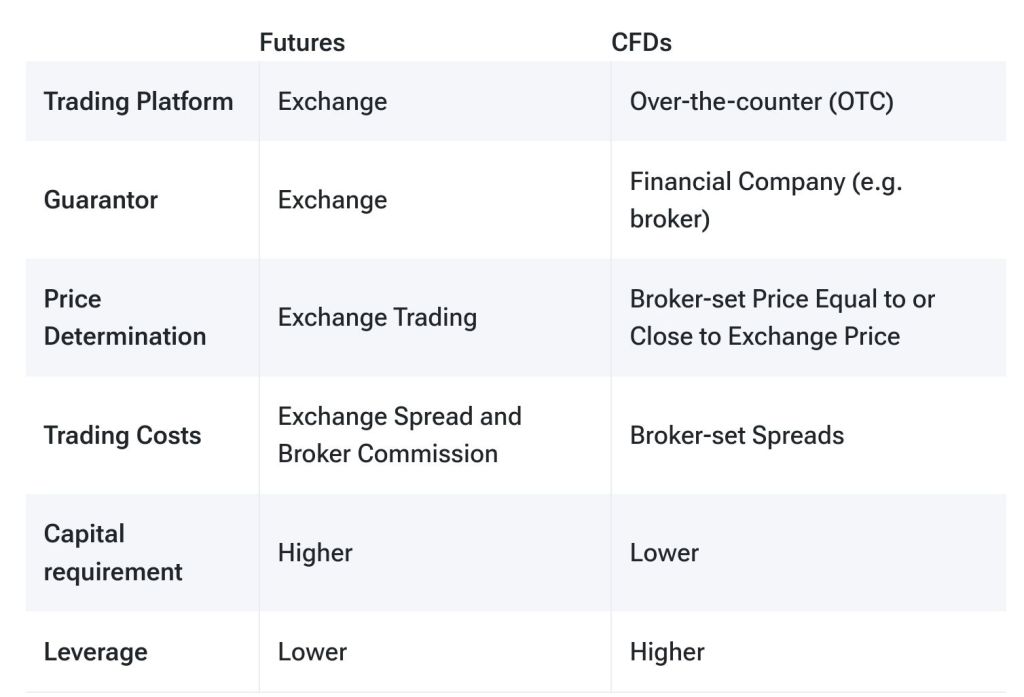
Futures are generally traded on exchanges, while CFDs are usually traded directly with brokers. The primary distinctions between the two lie in liquidity and financing. CFD orders are typically easier to execute and require a lower capital commitment, making them more accessible for many traders.
If you’re just starting out and want to explore trading with more flexibility and lower entry costs, CFDs could be an excellent choice. Conversely, if you’re seeking more complex trading opportunities, futures might be more appropriate.
Ultimately, your choice should align with your trading objectives. Both CFDs and futures can be effective instruments for enhancing your trading portfolio if used with the right strategy and research.
Key Takeaways
- CFDs and futures may appear similar at first glance since both are derivative instruments providing leverage, but their similarities end there.
- A CFD is a contract between a buyer and a seller, where the seller compensates the buyer for any increase in the value of a specific financial instrument from the opening to the closing price, and the buyer covers any losses.
- A futures contract is an agreement between two parties to buy or sell a financial asset at a predetermined price on a specified future date.
Understanding the Difference Between CFDs and Futures
If you’re new to trading, distinguishing between CFDs and futures can be challenging. Both provide opportunities for leveraged trading, but they function in distinct ways. Whether you’re an experienced trader seeking to diversify your strategies or a beginner trying to grasp the fundamentals, this guide will help you navigate the key aspects of CFDs and futures. Let’s get started!
What Are CFDs
So what is CFD trading?
CFD trading involves a contract between two parties—a buyer and a seller. In this agreement, the seller pays the buyer the difference if the price of a specific financial instrument rises between the opening and closing of the contract. Conversely, if the price falls, the buyer compensates the seller. The contract specifies when this price difference is determined.
CFD Example
It’s easier to understand what CFD is by giving an example. Let’s say a trader bought 1 CFD for mini Dow Jones at 5,400 points and sold this contract at a price of 5,700 points. Thus, the difference between the opening and closing of the index was 300 points. The trader’s profit, with the cost of one contract being $5, was $5 * 300 = $1,500. If the index had not risen, but had fallen by 300 points, the trader would have lost $1,500 on this deal. At first glance, CFD trading may not seem much different from trading currency pairs. Although CFD is a mechanism for trading a base asset, the asset itself underlying the CFD is not involved in the trading. This allows the trader to not work in the financial instrument market but to achieve the same financial result.
The Origin of CFDs
CFDs were created by British brokers as a way to attract clients to stock trading without incurring a specific tax. Technically, a CFD trade wasn’t classified as a direct stock transaction, thus avoiding tax obligations. Over time, CFDs became a popular option for those who couldn’t access traditional markets, such as individuals with limited capital.
CFDs (Contracts for Difference) were first developed in the early 1990s in London. The concept is credited to Brian Keelan and Jon Wood, who were working at UBS Warburg at the time. They created CFDs as a type of equity swap using margin trading, primarily to help hedge funds avoid the UK's stamp duty tax on stock transactions since no actual shares were exchanged during the trade. This made CFDs an attractive tool for institutions looking to minimize costs while maintaining exposure to stock movements.

The popularity of CFDs quickly spread in the late 1990s, when they were introduced to retail investors through online trading platforms. These platforms made it easier for individual traders to access real-time price quotes and execute trades instantly. By the early 2000s, CFDs had expanded to cover a range of underlying assets, including indices, commodities, and currencies, and had become a prominent instrument for traders globally.

For more details, you can read about the history of CFDs
What Are Futures Contracts?
A futures contract is a standardized agreement between two parties to buy or sell an underlying asset at a predetermined price on a specified future date. Here’s how it works:
Seller’s Obligation: The seller agrees to deliver the underlying asset to the buyer on the contract’s expiration date, as stipulated in the agreement.
Buyer’s Obligation: The buyer agrees to purchase the underlying asset from the seller at the agreed-upon price on that future date.
No physical documents are exchanged between the buyer and seller. Instead, these transactions occur through a broker’s platform. Additionally, the actual delivery of the underlying asset rarely takes place. Instead, the profit or loss is settled daily by adjusting the accounts of both parties based on the changes in the market price of the futures contract.
Futures contracts can involve a variety of underlying assets, such as stocks, indices, currencies, or commodities. The price of a futures contract fluctuates depending on market expectations about the future value of the underlying asset, which can be higher, lower, or equal to its current price.
Futures Example in Coffee market
Suppose you believe the price of coffee will increase over the next few months. You decide to buy a futures contract for coffee at $1.50 per pound. Each futures contract represents 37,500 pounds of coffee, so the total value of the contract is $56,250 (37,500 pounds x $1.50 per pound). The contract is set to expire in three months.
Now, let’s say that three months later, your prediction is correct, and the price of coffee rises to $1.80 per pound. You decide to sell the futures contract at this new price. The difference between your initial purchase price and the current selling price is $0.30 per pound ($1.80 – $1.50).
With 37,500 pounds in the contract, your profit would be $11,250 ($0.30 x 37,500 pounds). This gain reflects the increase in the coffee price during the contract period.
However, it’s important to note that if the price of coffee had decreased instead of rising, you would have faced a loss. For instance, if the price fell to $1.20 per pound, you would have incurred a loss of $11,250 instead. This example illustrates both the potential rewards and risks associated with trading coffee futures.
Futures Trading Risks
When trading futures, it’s crucial to understand that potential losses can be significant and, in some cases, unlimited.
Leverage Risks: Futures trading allows you to control a larger position than the amount of money you have. For instance, you might only need to put up 10-40% of the contract’s value as collateral. While this leverage can amplify profits, it also means you can lose much more than your initial investment. For example, with $10,000 in your account, you could secure a contract worth $100,000. If that contract gains value, you could make substantial profits, but if it loses value, your losses could match or exceed your original capital.
Margin Calls: If the market moves against your position, you may receive a “margin call,” requiring you to add funds to your account to maintain your position. If you cannot meet the margin requirement, your broker may close your position to limit further losses.
Daily Settlements: Unlike regular stocks, where you can hold onto a losing position, futures contracts are settled daily. This means gains or losses are calculated and reflected in your account every day, which can lead to sudden changes in your account balance.
Example Scenario: Suppose you have $10,000 and buy a crude oil futures contract for $60,000 with a 15% margin requirement, reserving $9,000 in your account. If the margin requirement suddenly rises to 40% due to market fluctuations, you’ll need $24,000 in your account. If you can’t meet this requirement, your position may be forcibly closed by your broker.
The Essence of Futures Trading
A futures contract is a legally binding agreement between two parties to buy or sell a financial asset at a predetermined price on a future date. These contracts can involve a variety of underlying assets, including commodities, currencies, and financial indices. Historically, the origins of futures trading date back to the 19th century, specifically to the Chicago Board of Trade (CBOT) in 1848, where farmers and merchants began using contracts to hedge against price fluctuations in agricultural products .
In practice, many futures contracts are settled financially before their expiration, meaning that the actual delivery of the asset is rarely executed. This characteristic makes futures trading appealing for speculators looking to profit from price movements without the necessity of owning the underlying asset .
Futures trading is often seen as riskier and more speculative than trading in stocks. This is largely due to the complexity of the contracts and the lower margin requirements, which can be as little as 5-10% of the contract’s value. For example, a trader might control a $100,000 futures contract by posting just $5,000 in margin . While this leverage can amplify potential returns, it also increases the risk of significant losses, making futures more suitable for short-term traders rather than long-term investors .
Overall, the strategic use of futures contracts can be a powerful tool for hedging and speculation, but they require careful consideration of the associated risks. For further insights into futures trading and its history, you can explore sources such as Investopedia and CME Group.
Thats all for part 1, we will talk about the benefits of each types next tine.

 Aaron Mai