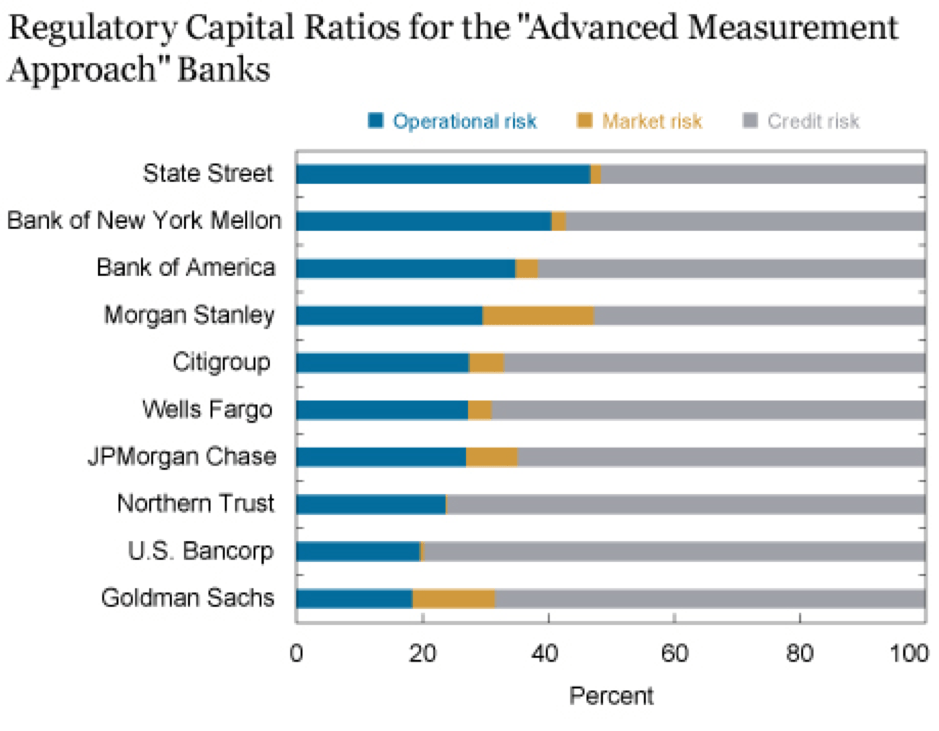
🔍 Key Reasons for Variability:
1. Business Model Differences
- Goldman Sachs and Morgan Stanley have large trading operations and investment banking activities, so they have higher Market Risk capital needs.
- State Street and Bank of New York Mellon are custodial banks that focus more on asset servicing and institutional clients, leading to higher Operational Risk allocations.
2. Risk Appetite & Internal Risk Models
- Under the AMA, banks can use internally developed models (subject to regulatory approval) to calculate operational risk. This means banks with better historical data, more conservative assumptions, or more automation might report lower capital needs.
- Some banks might over- or under-estimate operational risks depending on their risk culture and incident history.
3. Complexity of Operations
- Banks with global operations, extensive digital platforms, or large transaction volumes (e.g., JPMorgan Chase, Citigroup) face greater exposure to Operational Risk due to higher vulnerability to system failures, fraud, or regulatory breaches.
4. Trading vs. Lending Focus
- Banks focused more on traditional lending (Wells Fargo, U.S. Bancorp) tend to have lower Market Risk.
- Those involved in proprietary trading or derivatives (Goldman Sachs, Morgan Stanley) face greater Market Risk volatility.
The U.S. Federal Reserve mandates that banks maintain regulatory capital to safeguard against insolvency stemming from three primary risk categories: credit risk, market risk, and operational risk. The chart presented reflects the proportion of capital held by the ten largest U.S. banks under the “Advanced Measurement Approach” (AMA), offering insight into the distinct risk exposures across different institutions. While credit risk dominates uniformly across the board, the variability in operational and market risk capital ratios is both striking and revealing.
Credit risk capital remains the highest proportion for all banks, reflecting the foundational nature of lending and counterparty risk within the banking system. However, the more revealing story lies in the significant divergence in operational and market risk exposures. This divergence is not arbitrary—it stems directly from the unique business models, risk appetites, and operational structures of each institution.
Banks like Goldman Sachs and Morgan Stanley, which are heavily invested in trading, derivatives, and capital markets, naturally face heightened market risk, necessitating higher capital allocations in this category. In contrast, State Street and Bank of New York Mellon, which operate primarily as custodial and asset servicing banks, demonstrate substantially higher proportions of operational risk capital. These banks manage large volumes of client assets, leading to greater exposure to process errors, system failures, and compliance breaches, all of which contribute to operational risk.
In addition to business model differences, the use of internal risk models allowed under the AMA introduces another layer of variability. Banks are permitted to develop their own models to estimate operational risk capital requirements, subject to regulatory approval. This flexibility means that differences in data quality, historical loss experiences, and modeling assumptions can significantly alter the capital ratios reported—even among similarly sized institutions.
Furthermore, organizational complexity plays a vital role. Global, diversified banks such as JPMorgan Chase and Citigroup tend to display more balanced risk profiles, with meaningful allocations to all three risk categories. Their wide-ranging operations across commercial banking, asset management, investment banking, and retail lending expose them to a broad spectrum of risks, necessitating a more diversified capital strategy.
In conclusion, the variability in operational and market risk capital among these leading banks underscores the importance of business model specialization, internal risk management practices, and organizational complexity in shaping capital adequacy. As banking continues to evolve with digital transformation and regulatory scrutiny, these differences will remain central to how financial institutions manage and disclose risk.

 Aaron Mai